



Trump tax reform and Americans Overseas
2 min
14-12-2017
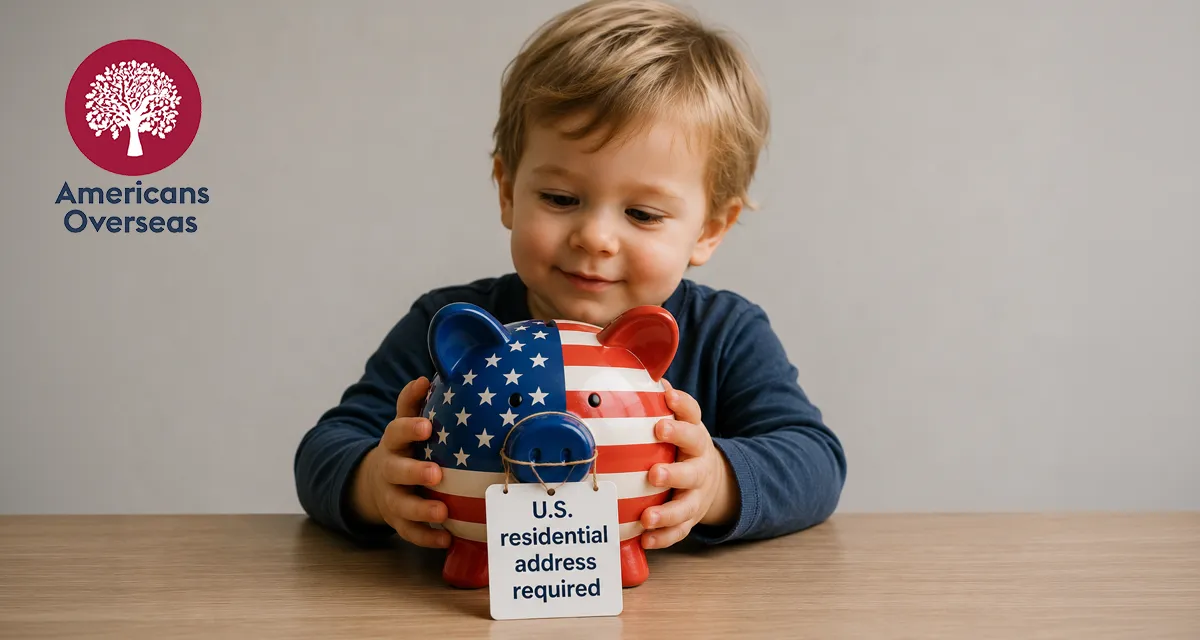
The new Trump Account program promises a $1,000 government contribution for eligible U.S. citizen children born between 2025 and 2028. But for American families abroad, eligibility may not mean easy access. The child may qualify with a valid Social Security number, but the account-opening process could still require a U.S. residential address or U.S. banking access.
The new Trump Account program promises a $1,000 government contribution for eligible American children. But for U.S. citizen children living outside the United States, the practical question is not only whether they qualify.
It is whether their parents can actually open the account.
The law does not appear to exclude Americans abroad. A U.S. citizen child with a valid Social Security number may qualify even if the family lives in the Netherlands, Germany, France, Spain, the United Kingdom or elsewhere. But the way the program is being built – with BNY as financial agent and Robinhood involved in the app and infrastructure – may create practical barriers for families without a U.S. residential address.
For American parents overseas, this is the important point: your child may be eligible on paper, but access may not be straightforward in practice.
In April 2026, the U.S. Treasury announced that BNY would serve as financial agent for the new Trump Accounts program. BNY will help manage the initial accounts and support the development of the Trump Accounts app. Treasury described the app as a secure platform through which families can access and manage the accounts.
Robinhood also announced that it had been selected, together with BNY, to support the Trump Accounts infrastructure. According to Robinhood, the accounts are tax-advantaged investment accounts for U.S. citizens under the age of 18, with a $1,000 government contribution for children born between 2025 and 2028.
The official Trump Accounts website describes the basic promise clearly: $1,000 for every American child born between January 1, 2025, and December 31, 2028.
The program is expected to go live on July 4, 2026.
The basic eligibility conditions are limited. The child must be a U.S. citizen. The child must have a valid Social Security number. The child must fall within the relevant age and birth-date rules.
For the $1,000 government contribution, the key group is U.S. citizen children born between January 1, 2025, and December 31, 2028. Treasury and IRS materials also refer to the requirement that the child have a valid Social Security number.
There is no obvious rule saying that the child must live in the United States.
That matters for families abroad. A child born in Amsterdam, Berlin, Paris, Madrid or London may still be a U.S. citizen if the citizenship rules are met. In many cases, this depends on whether the U.S. citizen parent transmitted citizenship to the child under U.S. nationality law.
But citizenship alone is not enough in practice. The child will generally need a Social Security number. For children born abroad, that often starts with a Consular Report of Birth Abroad, a U.S. passport application and an SSN application.
The problem is not necessarily the law. The problem may be the front door.
Many American families abroad know this issue already. A U.S. rule may technically include them, while the bank, broker, app or administrative system behind the rule is built mainly for people with a U.S. address.
That may also become the issue with Trump Accounts.
Robinhood is a U.S.-based brokerage platform. Standard brokerage onboarding in the United States usually involves identity checks, tax certification, banking links and residential-address requirements. Families living abroad may not fit neatly into that system.
BNY, as financial agent and custodian infrastructure provider, is also a U.S.-regulated financial institution. Like many U.S. banks and brokers, it may have compliance restrictions around non-resident account holders.
At the time of writing, the key unresolved question is simple:
Can a U.S. citizen child living abroad open and use a Trump Account without a U.S. residential address?
Until Treasury, BNY and Robinhood publish detailed onboarding rules for non-resident families, that question remains open.
For Americans overseas, the Trump Account is not just a political announcement or a savings product. It raises practical questions about citizenship, documentation, banking access and local taxation.
The first question is whether the child can be registered at all. If the app requires a U.S. residential address, many families abroad may not be able to complete the process. Some families use a relative’s address or a U.S. mailing address, but that can create complications. A mailing address is not always the same as a residential address, especially for financial-account compliance.
The second question is whether the account can be funded. Even if the $1,000 government contribution is deposited, parents or relatives may want to add money. If contributions require a U.S. bank account, families who only have foreign bank accounts may face another barrier.
The third question is how the account is treated in the country where the family lives. A tax-advantaged account under U.S. law is not automatically tax-advantaged in the Netherlands, Germany, France, Spain, the United Kingdom or any other country. Local tax treatment may differ. In some countries, the account may be treated as a regular investment account or as part of taxable wealth.
The fourth question is whether the account creates additional reporting. U.S. persons abroad often already deal with FBAR, FATCA, Form 8938, foreign bank reporting and local tax disclosure. Parents should not assume that a U.S. government benefit is administratively simple when the child lives abroad.
The Trump Account may also bring U.S. citizenship questions to the surface.
Some families abroad do not think of their child as American in daily life. The child may have been born outside the United States, may live entirely outside the United States and may hold another nationality. But if one parent is a U.S. citizen, the child may still have acquired U.S. citizenship at birth, depending on the parent’s history and the applicable rules.
That can be positive in the context of a benefit such as the Trump Account. But it can also raise broader questions.
If the child is a U.S. citizen, that status may come with future U.S. tax and reporting obligations. The child may need an SSN. The child may later be affected by bank questions, investment restrictions or reporting rules.
For families abroad, it is therefore important not to look at the $1,000 contribution in isolation. The bigger question is whether the child is a U.S. citizen, whether that status has been documented and what that may mean later.
This is still a developing program. The safest approach is to prepare calmly, without rushing into workarounds.
If your child is a U.S. citizen but does not yet have a Social Security number, that is the first practical step to review. An SSN is likely to be necessary for the Trump Account and may also be important for future U.S. tax filing, passport, banking and administrative matters.
If your child was born abroad and you have not yet confirmed whether U.S. citizenship applies, now is a good moment to clarify this. U.S. citizenship for children born abroad depends on specific rules. The answer is not always obvious.
If you want to claim the $1,000 contribution but live outside the United States, wait for the official onboarding rules before taking action. Using a U.S. address that is not your actual residence may create complications, especially for financial-account compliance and tax purposes.
If the account becomes available to non-resident families, also check how it may be treated in your country of residence. A U.S. tax-advantaged account can still have local tax consequences.
The Trump Account program may be valuable. A $1,000 government contribution for a child is meaningful, especially if invested early and left to grow.
But for Americans abroad, eligibility and access are not the same thing.
Your child may qualify under the law, but the account may still be difficult to open or manage if the system is built around U.S. residents. The most important issues to watch are the address requirement, SSN requirement, funding method, portability rules and local tax treatment.
For now, the best approach is to clarify your child’s U.S. status, gather the required documentation and wait for the program’s final non-resident onboarding rules.
At Americans Overseas, we regularly speak with families who discover U.S. citizenship and tax questions only when a bank, passport application, inheritance issue or financial product brings them to the surface.
The Trump Account program may become another moment when those questions arise.
If you would like to discuss whether your child may be considered a U.S. citizen, whether an SSN is needed, or what U.S. tax obligations may mean for your family abroad, our team is available for a free, no-obligation intake conversation.
Contact us for more information

Co-founder
Michael Littaur, co-founder of Americans Overseas, discovered his U.S. tax liability only after selling his business. Together with Daan Durlacher, he founded Americans Overseas in 2014 to inform and support others with U.S. tax issues.
Read moreQuestions about Trump Accounts, U.S. citizen children abroad, Social Security numbers and access for American families living outside the United States.
U.S. citizens and resident aliens who live abroad are generally required to file a federal income tax return and pay taxes on their worldwide income.
Read more... about Who is required to file taxes in the US?Yes, US citizens are required to file taxes on their worldwide income, regardless of where they are living.
Read more... about Do US citizens living abroad still have to file taxes in the US?Received an American check? You can cash your check in the following ways: cash the check at your own bank, transfer to another person (endorsement), cash checks using an online service or cash the check by another bank.
Read more... about How can I cash my US check?US citizens living abroad may be required to file Form 2555 and/or Form 1116 to claim the foreign-earned income exclusion.
Read more... about Are there any special tax forms required for US citizens living abroad?FBAR (Foreign Bank Account Report) filing is the requirement for certain U.S. individuals and entities to report their foreign financial accounts to the Financial Crimes Enforcement Network (FinCEN) of the U.S. Department of Treasury. The FBAR filing requirement applies to U.S. persons who have a financial interest in, or signature authority over, one or more foreign financial accounts if the aggregate value of those accounts exceeds $10,000 at any time during the calendar year.
Read more... about What is FBAR filing?A U.S. citizen child with a valid Social Security number may qualify if the child meets the birth-date and age requirements. The key practical question is whether the account can be opened from outside the United States.
Yes. The $1,000 government contribution is linked to U.S. citizen children with a valid Social Security number. An ITIN is not expected to be enough.
The basic eligibility rules do not appear to require U.S. residence. However, the account-opening process may still create practical barriers for families living abroad.
The program is being built with BNY and Robinhood. U.S. financial institutions and brokerage platforms often require a U.S. residential address and U.S. banking access, which can be difficult for non-resident families
Be careful. A mailing address is not always the same as a residential address. Using an address that is not your actual residence can create compliance, tax and banking issues.
Not necessarily. A U.S. tax-advantaged account is not automatically tax-advantaged in another country. Local tax treatment may differ, especially in countries that tax wealth, investment income or foreign accounts.
First clarify whether your child is a U.S. citizen. If citizenship applies, you may need to consider a Consular Report of Birth Abroad, a U.S. passport and a Social Security number.
It may be better to wait until Treasury, BNY and Robinhood publish clear rules for non-resident families. Rushing through the process with address workarounds is not advisable.