



IRS Enforcement 2026: What Americans Abroad Should Know
4 min
02-03-2026
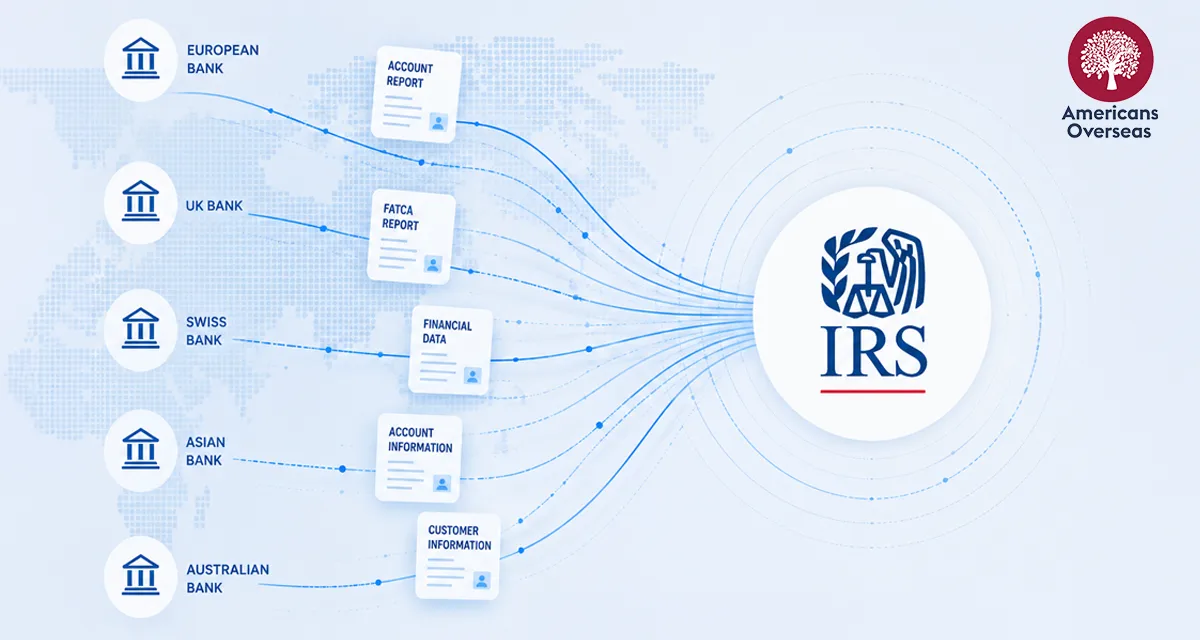
The IRS already receives FATCA data on Americans abroad every year. This IRS FATCA data is supposed to help identify U.S. taxpayers who may not be meeting their foreign account reporting obligations. A new Treasury watchdog report shows that, so far, the IRS has taken limited enforcement action based on that information. That may sound reassuring. It is not. The obligations remain, the data keeps coming in, and the gap between identification and enforcement may not stay open forever.
A new report from the U.S. Treasury watchdog, published on April 8, 2026, looks at how the IRS uses the information it receives under FATCA. The findings are striking. The IRS identified 405 taxpayers as likely non-compliant, holding around $6.2 trillion in foreign accounts.
From a high-risk subset of 164 of those taxpayers, only 12 were actually examined. Another 241 received letters but no penalties at all, even though the law allows for an automatic $10,000 fine. The IRS has spent more than $680 million running FATCA, and pushed back against nearly every recommendation TIGTA made to improve enforcement.
For Americans living abroad, this is not a sign that the rules have changed. The reporting obligations are the same. The data still arrives at the IRS every year. What the report actually shows is a gap between identification and follow-up — and gaps like that tend to close.
The full title of the report is The IRS Has Not Successfully Addressed the Highest Balance Foreign Account Tax Compliance Act Nonfilers. It was written by TIGTA, the Treasury Inspector General for Tax Administration. TIGTA is the office that audits the IRS itself.
The report focuses on Campaign 896, an internal IRS program that uses FATCA data to find taxpayers who appear not to have filed Form 8938, the form for reporting foreign financial assets. The campaign began as a way to turn the mountain of bank-reported information FATCA generates into actual cases.
In other words, the report asks a simple question: what does the IRS actually do with the FATCA data it receives from foreign banks?
Campaign 896 flagged 405 individual taxpayers as likely non-compliant. The combined value of their foreign accounts came to nearly $6.2 trillion.
The IRS split these taxpayers into two groups.
In the first group, 164 taxpayers were considered the highest risk. Their average unreported foreign account balance was about $1.3 billion each. They were referred for possible examination. Of those 164, only 12 were actually examined. That is about 7.3%. Of those 12, only 5 ended up with any adjustment: $39.7 million in additional tax, and roughly $80,000 in penalties.
For a group with $1.3 billion in unreported balances each on average, those numbers are remarkably low.
In the second group, 241 taxpayers received letters instead. 225 received “educational letters,” which require no response. 16 received “soft letters,” which ask for a response but do not start an examination. None of these 241 taxpayers were assessed the initial $10,000 FATCA penalty for not filing Form 8938, even though the statute provides for it automatically.
So out of 405 taxpayers identified as non-compliant, the IRS opened 12 examinations, made adjustments in 5, and let the rest receive at most a letter.
The IRS has spent more than $680 million putting FATCA into operation and supervising it. The TIGTA report concludes that, despite this investment, the IRS “has taken limited enforcement actions, even when it has identified egregious noncompliance.”
TIGTA made three recommendations to improve how the IRS uses FATCA data. The IRS pushed back on nearly all of them. It disagreed with assessing the FATCA penalties available under Campaign 896. It disagreed with introducing performance measures for the program. It agreed only to evaluate whether information from Form 1099 could be added to Campaign 896 data, and even there, part of the recommendation was rejected.
In its formal response, the IRS made a statement that has drawn attention in tax press coverage: it described FATCA as “a data source, not a compliance program.” That phrasing is significant. It suggests the IRS sees FATCA primarily as a way to gather information, with enforcement decisions taken separately and elsewhere.
The TIGTA numbers cannot be read in isolation. In 2025, the IRS lost more than half of its budget and around 742 agents from its Large Business and International division. This division, often referred to as LB&I, handles complex international cases, including those involving Americans overseas. The cuts came as part of broader downsizing under the Trump administration.
In other words, the IRS did not stop receiving FATCA data. It lost much of the workforce that would have acted on it. The 12-out-of-164 examination rate reflects, in part, a shrunken enforcement office trying to cover the same ground with far fewer people.
It is tempting to read a report like this and conclude that the rules are softening, that enforcement is over, or that Americans abroad can quietly stop filing. That conclusion is not supported by the underlying facts.
Here is what the report does not say.
The filing requirements have not changed. If you are a U.S. citizen or a green card holder, you are still required to file a U.S. tax return each year, regardless of where you live or where your income comes from. If your foreign accounts cross the relevant thresholds, you are still required to file an FBAR, officially FinCEN Form 114, and, where applicable, Form 8938. None of those obligations have been suspended.
The data is still arriving. Banks across Europe and the rest of the world continue to report U.S. account holders to the IRS every year through FATCA. The TIGTA report does not say the data flow has slowed. It says the IRS is sitting on most of the data without acting on it.
The statutes of limitations are still running. The IRS generally has six years to assess FBAR penalties and six years for substantially understated foreign income. In cases involving fraud, there is no time limit at all. A quiet year now does not erase your file. It just means the file is still open.
Two things are likely to come next, and both deserve attention.
The first is that political and budget situations change. Today’s IRS is shrunken. A future IRS may not be. The same IRS FATCA data already in the system can be used by a re-staffed enforcement office five or six years from now, well within most statute-of-limitations windows. Information collected today is not bound by today’s enforcement capacity.
The second is automation. The Bisignano reorganization announced earlier this year points toward a smaller IRS workforce paired with more automated matching, scoring, and case selection. Identifying non-compliant taxpayers is the part that does not require many people. The IRS is already doing that, as the 405-name list shows. Closing the gap between identification and follow-up is mostly a question of when, not whether.
This report does not change our advice to Americans abroad. If anything, it makes the next step clearer.
If you are already filing your U.S. returns, keep doing so. Keep your records, file on time, and do not assume the reporting environment has loosened.
If you have not been filing and you are reading this with a sinking feeling, do not wait for the IRS or your bank to make the next move. A structured catch-up through one of the IRS programs designed for this situation, such as the Streamlined Foreign Offshore Procedures, may be available if your past non-compliance was non-willful.
That describes many of the people we speak with at Americans Overseas: lifelong expats, dual nationals and people who only recently learned they hold U.S. nationality. Coming forward voluntarily is, in almost every case we have seen, less painful and less expensive than being approached after the fact.
If you are not sure whether the rules apply to you, this is a good moment to find out. Many Americans living overseas (including those who were born in the United States but left as children, or who acquired U.S. citizenship through a parent) first hear about their U.S. obligations from their bank rather than from the IRS. By the time the bank asks, the conversation is already harder.
This TIGTA report is, in plain terms, a report about a gap. The IRS knows who has foreign accounts. It is not, right now, doing very much about it. Both halves of that sentence matter.
The first half is why the rules are not going to disappear. The second half is why some people assume they already have. The central lesson is that IRS FATCA data should not be ignored simply because enforcement has been limited so far.
We would rather you read the report as it is: a snapshot of an enforcement system that is currently quiet, not one that has been switched off.
If you would like to talk through what this means for your own situation, our team at Americans Overseas is available for a free, no-obligation intake conversation.
We, the founders of Americans Overseas, were born in the Netherlands and received our American citizenship through our (American) mother.
When we first learned about the U.S.–Netherlands tax treaty around 2013, we felt disbelief (“this can’t be true”), anger (“how can they do this?”), fear (“will I get fined or have problems?”), and panic (“what should I do?”).
Unfortunately, it is true that there is a U.S. tax obligation for Dutch citizens who acquired American nationality by birth. There was no information from local authorities, the U.S. consulate referred us to the IRS, and the IRS itself was impenetrable.
That is why we started this initiative: to help others with reliable information, to prevent unnecessary panic, and to offer free, no‑obligation assistance. When needed, we can connect you with a network of affordable professionals (accountants) who can help you meet your U.S. tax obligations.
Contact us for more information

General Manager & Partner
Linda Mabelis is the General Manager and Owner at Americans Overseas, dedicated to helping individuals find the right tax attorney for their unique situations. With extensive work experience and a deep understanding of the complexities facing Americans Overseas, Linda is committed to providing personalized and effective solutions.
Read moreBelow we answer common questions about IRS FATCA data, foreign account reporting and what the TIGTA report may mean for Americans living abroad.
Yes. Under FATCA, many foreign financial institutions report information about U.S. account holders to the IRS. This can include information about foreign bank accounts and other financial assets held outside the United States.
No. The report shows that the IRS has taken limited enforcement action in the cases reviewed, but it does not mean FATCA enforcement has stopped. The IRS continues to receive FATCA data, and enforcement priorities may change.
Yes. U.S. citizens and green card holders generally must file a U.S. tax return every year, even if they live outside the United States and earn income abroad.
Form 8938 is used to report certain foreign financial assets to the IRS. It is separate from the FBAR and may apply when foreign financial assets exceed specific thresholds.
The FBAR, officially FinCEN Form 114, is used to report foreign bank and financial accounts. FATCA reporting often refers to Form 8938, which reports certain foreign financial assets to the IRS. Some Americans abroad may need to file both.
If your failure to file was non-willful, you may be able to catch up through an IRS procedure such as the Streamlined Foreign Offshore Procedures. This route is often used by Americans abroad who did not know they had a U.S. filing obligation.
No. Limited enforcement today does not mean there is no future risk. The data may already be in the IRS system, and future enforcement could rely more on automation, matching and risk scoring.
Take the request seriously. A FATCA request from your bank may indicate that your U.S. status needs to be clarified. It is better to understand your filing obligations before the issue becomes more urgent.