

5 things American expats living in El Salvador need to know about US tax obligations
3 min
14-07-2022
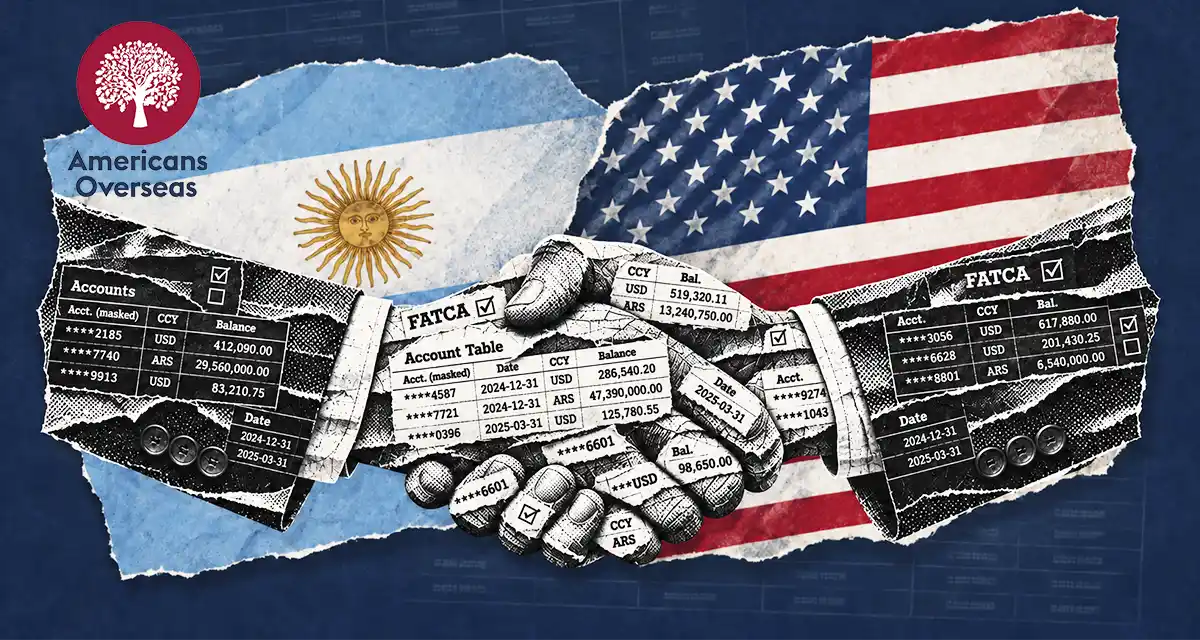
If you are an American living abroad, your foreign bank may send information about your accounts to the United States. Argentina’s first exchange of financial data with the US shows that FATCA reporting is not limited to Europe. It also does not replace the FBAR, Form 8938 or other forms you may need to file yourself.
Many Americans living outside the United States have bank accounts in their country of residence. Others have accounts in several countries because they have moved, worked internationally or kept savings in a previous country.
It can be easy to assume that an account held outside Europe or far from the United States will not be reported to the US authorities. Argentina’s agreement with the United States shows why that assumption may be wrong.
The United States has FATCA arrangements with many jurisdictions. These arrangements allow information about certain accounts held by US persons to be sent to the US Internal Revenue Service.
Argentina and the United States signed an agreement to implement the Foreign Account Tax Compliance Act, better known as FATCA, on 5 December 2022. The agreement has been in force since 1 January 2023.
Under this agreement, Argentine financial institutions report certain accounts to the Argentine tax authority. That authority can then send the information to the IRS.
Argentina prepared its banks for the first exchange during 2024. An official Argentine government report confirms that the first automatic exchange of financial information took place that year.
If an Argentine financial institution identifies an account as reportable under FATCA, the information may include:
This does not mean that every account in Argentina is automatically reported. Banks first check whether the account and its holder fall under the FATCA rules. Thresholds and exceptions may also apply.
Yes. The exchange works in both directions, but the two countries do not provide exactly the same information.
For an Argentine reportable account held at a US financial institution, the United States may provide the account holder’s identifying details, the account number and certain financial information. This can include interest, US-source dividends and certain other income from US sources.
The information that the United States sends to Argentina under this agreement does not include the account balance.
FATCA reporting is not limited to banks in the Netherlands, Germany, France or Spain. An account in Argentina or another participating jurisdiction may also be covered.
Moving to another country does not automatically end your US reporting duties. Neither does moving your savings to a bank in another country.
Whether an account is reported depends on the agreement, the type of financial institution, the account and the status of the account holder. Not every account is treated in the same way.
No. FATCA reporting by a financial institution is separate from your own filing responsibilities.
A US person generally has to file an FBAR if the combined value of their reportable foreign financial accounts exceeded $10,000 at any time during the calendar year.
The FBAR is filed separately with the Financial Crimes Enforcement Network. It is not part of your US income tax return.
If you have accounts in more than one country, you generally consider the combined value of all accounts covered by the FBAR rules. An individual account does not have to exceed $10,000 on its own.
Certain taxpayers must also file Form 8938 with their US income tax return. This form covers specified foreign financial assets when their total value exceeds the threshold that applies to the taxpayer.
Form 8938 and the FBAR have different thresholds and do not cover exactly the same assets. Filing one does not automatically remove the need to file the other.
Depending on your circumstances, you may need to file:
A FATCA report from your bank does not replace either form.
FATCA gives the IRS information that may be compared with information reported by taxpayers. This does not mean that every difference automatically leads to an audit or penalty.
Differences can also have a reasonable explanation. For example, FATCA, FBAR and Form 8938 do not always use the same definitions or reporting methods.
You should still make sure that your own filings are complete and consistent. If information appears to be missing or incorrect, consider having your situation reviewed before filing an amendment or overdue form.
Start by making a complete list of the foreign financial accounts you owned or controlled during the year. Include accounts in your current country of residence and accounts you kept elsewhere.
For each account, record:
If your bank’s FATCA questions have made you aware of your US filing duties for the first time, do not assume that the bank’s report has resolved them. The appropriate next step depends on which forms you should have filed and why they were not filed.
Argentina and the United States also signed a separate Agreement on Reciprocal Trade and Investment on 5 February 2026. It covers subjects such as tariffs, market access and investment.
An official US trade report described that agreement as pending entry into force. It does not change the FATCA rules. It is another sign of the growing cooperation between the two countries.
We, the founders of Americans Overseas, were born in the Netherlands and received our American citizenship through our (American) mother.
When we first learned about the U.S.–Netherlands tax treaty around 2013, we felt disbelief (“this can’t be true”), anger (“how can they do this?”), fear (“will I get fined or have problems?”), and panic (“what should I do?”).
Unfortunately, it is true that there is a U.S. tax obligation for Dutch citizens who acquired American nationality by birth. There was no information from local authorities, the U.S. consulate referred us to the IRS, and the IRS itself was impenetrable.
That is why we started this initiative: to help others with reliable information, to prevent unnecessary panic, and to offer free, no‑obligation assistance. When needed, we can connect you with a network of affordable professionals (accountants) who can help you meet your U.S. tax obligations.
Contact us for more information

General Manager & Partner
Linda Mabelis is the General Manager and Owner at Americans Overseas, dedicated to helping individuals find the right tax attorney for their unique situations. With extensive work experience and a deep understanding of the complexities facing Americans Overseas, Linda is committed to providing personalized and effective solutions.
Read moreWhat Argentina's exchange with the US shows about foreign accounts and your own reporting responsibilities.
Yes. Under FATCA, certain foreign financial institutions may report information about accounts held by US persons. The exact process depends on the country and its arrangement with the United States.
No. Moving abroad or moving between foreign countries does not automatically end your US reporting duties. The forms you must file depend on your US tax status, accounts, assets and personal circumstances.
No. FATCA reporting by your bank is separate from your own filing duties. Depending on your circumstances, you may still need to file an FBAR, Form 8938, both forms or neither.
Generally, yes. The FBAR threshold is based on the combined value of all foreign financial accounts covered by the rules. If that total exceeded $10,000 at any time during the year, reportable accounts may need to be included even if no single account exceeded $10,000.
No. Argentine financial institutions first determine whether an account and its holder fall under the FATCA reporting rules. Thresholds and exceptions may apply.