



New US tax proposals for Americans abroad: what could actually change?
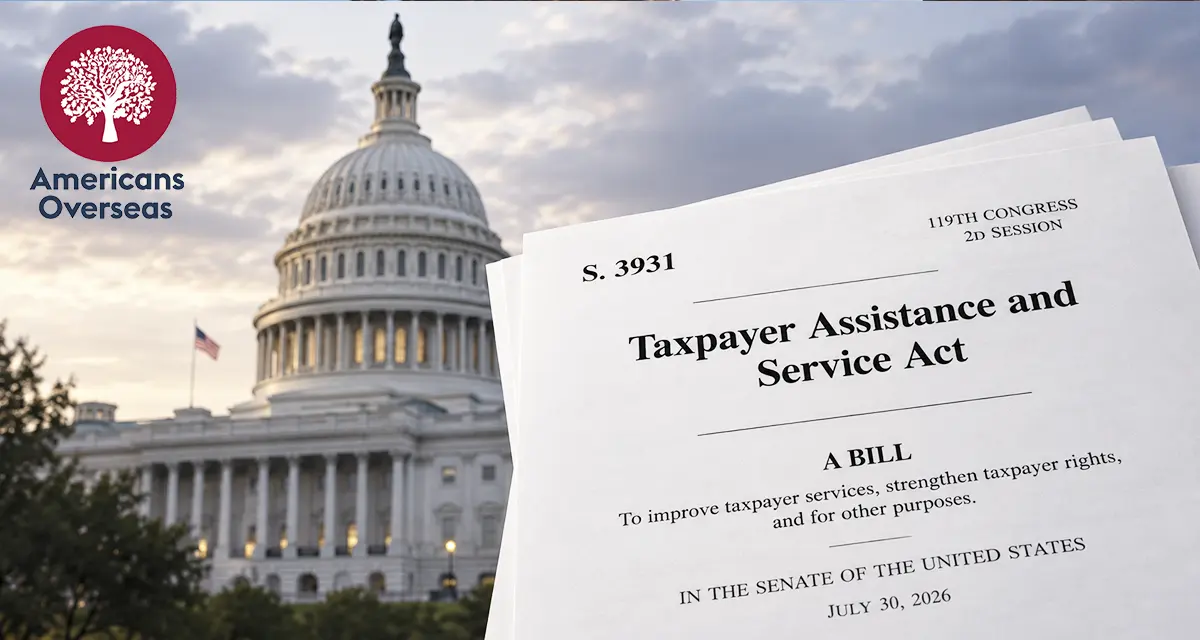
A new bill in the US Senate contains several proposals that could affect Americans living abroad. Some could make dealing with the IRS and international reporting requirements easier. But several of the changes that would have had the most direct financial impact have already been removed.
The legislation is called the Taxpayer Assistance and Service Act (TAS Act, S.3931). It was approved by the Senate Finance Committee on July 30, 2026, by a vote of 26 to 1.
However, the TAS Act is not law yet. It still has to move through Congress and be signed into law before any changes take effect. The text can also still be amended.
So what is still being proposed for Americans abroad, what has been dropped, and does any of this change what you need to do today?
What is the Taxpayer Assistance and Service Act?
The TAS Act is a broad piece of legislation containing more than 60 proposals intended mainly to improve IRS procedures, taxpayer rights and taxpayer services.
Only a small part of the bill specifically deals with US citizens living outside the United States.
An earlier discussion draft contained six measures aimed at Americans abroad. Since then, some have been changed substantially and others have disappeared completely.
Here is where the main proposals stand now:
| Proposal | Current status |
|---|---|
| Simplify FBAR and international reporting | Still included, but as a study |
| Study the compliance burden for Americans abroad | Included |
| Simplify foreign currency and mortgage rules | Removed |
| Increase the simplified Foreign Tax Credit threshold | Removed |
| Give Americans abroad more time to respond to certain IRS notices | Included |
| Possible expatriation certification waiver for certain dual citizens | Removed |
For Americans abroad, that means the current bill is considerably less ambitious than the original proposals.
Foreign currency mortgages: a proposed change that was removed
One of the most practically important proposals concerned foreign currency gains.
For US tax purposes, transactions in euros, pounds and other currencies sometimes have to be measured in US dollars. For an American living abroad, this can create unexpected tax consequences.
Consider an American living in the Netherlands with a mortgage denominated in euros.
If the euro-dollar exchange rate changes substantially between the time the mortgage is taken out and the time it is repaid or refinanced, US tax rules can in some circumstances produce a taxable foreign currency gain.
That can happen even though the homeowner has not made a comparable economic profit when the transaction is viewed in euros.
The original TAS Act proposal would have made several changes to the foreign currency rules. Among other things, it would have addressed certain gains and losses connected with qualifying foreign residences and mortgages, increased the exemption for certain personal foreign currency gains from $200 to $1,000, and simplified the exchange rates that could be used for certain income and expenses.
Those provisions were removed during the Senate Finance Committee process.
For now, the existing US foreign currency rules remain in place.
This is particularly relevant if you are considering refinancing, repaying or otherwise restructuring a mortgage outside the United States.
Foreign Tax Credit: proposed simplification also removed
Another proposal concerned the Foreign Tax Credit (FTC).
Americans abroad can often use the Foreign Tax Credit to offset US income tax with income tax already paid in their country of residence. It is one of the main mechanisms that helps prevent the same income from being taxed twice.
Under current law, some taxpayers with relatively small amounts of foreign tax on passive income can claim the credit without completing the full Foreign Tax Credit calculation.
One of the conditions is that qualifying foreign taxes do not exceed $300 for an individual or $600 for a married couple filing jointly.
The original TAS Act proposal would have increased those amounts to $1,000 for an individual and $2,000 for a joint return, with inflation adjustments in later years.
Importantly, this would not have eliminated the need to file a US tax return, nor would it necessarily have increased the amount of Foreign Tax Credit available.
The main benefit would have been less paperwork for more taxpayers.
This proposal was also removed during the committee process, so the existing thresholds continue to apply.
The proposed expatriation exception that was dropped
An earlier version of the legislation also contained a proposal relevant to some people considering giving up US citizenship.
Under current US expatriation rules, someone who relinquishes US citizenship generally has to certify on Form 8854 that they complied with their US federal tax obligations for the five years preceding expatriation.
Failure to make that certification is one of the circumstances that can cause someone to be treated as a covered expatriate.
The original proposal would have allowed the Treasury Secretary to waive this five-year certification requirement for certain lower-income dual citizens who met specific conditions. These included having limited ties to the United States, maintaining a tax home outside the US and having only a limited amount of unpaid US tax.
It is important not to interpret this too broadly.
The proposal would not have abolished the US exit tax or the covered expatriate rules. It would have created a narrow exception to one particular certification requirement for qualifying individuals.
The provision was removed before S.3931 was formally introduced in February 2026 and is not included in the current bill.
Anyone considering renouncing US citizenship therefore still needs to take the existing five-year tax compliance requirement into account.
What is still in the TAS Act for Americans abroad?
Although several of the more substantial proposals were removed, three measures aimed specifically at Americans abroad remain.
1. A study into simplifying FBAR and international reporting
The original proposal would have gone further by allowing taxpayers to file the FBAR together with their federal tax return instead of filing it separately through FinCEN.
The current bill does not do that.
Instead, Treasury would have to examine whether FBAR and other international information reporting requirements could be combined, coordinated or simplified.
That could eventually lead to changes, but a study does not itself change any filing obligation.
If you currently have an FBAR filing requirement, the TAS Act does not remove it.
2. A study into the tax burden faced by Americans abroad
The Government Accountability Office (GAO) would also be required to examine the practical burden of US tax compliance for citizens living outside the country.
Among other issues, the study would look at whether lower- and middle-income Americans abroad can:
- comply with US tax rules accurately and affordably;
- communicate effectively with the IRS and FinCEN; and
- obtain normal financial services while living overseas.
Treasury would subsequently consider possible administrative or legislative solutions.
Again, this would not immediately change the tax rules. But it would formally examine some of the practical problems Americans abroad have faced for years.
3. More time to respond to certain IRS notices
One of the few concrete procedural changes still in the bill would give taxpayers outside the United States more time to respond to certain IRS math error notices.
Instead of the normal 60-day period, qualifying taxpayers abroad would have 120 days.
For someone dealing with the IRS from another country, where postal delays, time differences and difficulties contacting the IRS can make deadlines harder to manage, the additional time could be useful.
Another change: international information return penalties
The July Senate Finance Committee process also added the Fairness in Foreign Filing Act to the TAS Act.
This provision deals with penalties connected with certain international information returns.
It would establish a more standardized process before the IRS assesses penalties for failing to file certain forms involving foreign businesses, trusts and gifts. Taxpayers would have a clearer opportunity for administrative review before a penalty is assessed.
It would also help align filing deadlines for certain international information returns with regular tax return deadlines.
This could be particularly relevant because US tax penalties for international information reporting can be substantial, even in situations where little or no US income tax is ultimately due.
For Americans abroad who own foreign companies, have interests in foreign trusts or encounter other international reporting requirements, this part of the legislation could therefore be significant.
But, like the rest of the TAS Act, these changes only take effect if the legislation becomes law.
What the TAS Act does not change
This is perhaps the most important point for Americans living abroad.
The TAS Act does not replace US citizenship-based taxation with residence-based taxation.
It does not end the general US tax filing obligation for Americans living abroad.
And it does not currently remove major international reporting regimes such as:
The bill does include proposals to examine whether some international reporting requirements could be simplified. But this is primarily a bill about tax administration and taxpayer procedures, not a fundamental rewrite of how the United States taxes its citizens abroad.
What happens next?
Approval by the Senate Finance Committee was an important legislative step, but it does not make the TAS Act law.
As of September 2026, the legislation has been approved by the committee and still needs to progress through Congress before it can take effect.
The wording can also change during that process. Provisions currently included could be amended or removed, and proposals that have already been dropped could theoretically return in another form.
Until legislation is actually enacted, the existing US tax and reporting rules continue to apply.
What does this mean for you?
If you are a US citizen living abroad, you do not need to change the way you file your US taxes because of the TAS Act at this stage.
Existing filing and reporting requirements continue to apply.
That is particularly important if you have:
- a mortgage denominated in a foreign currency;
- investments outside the United States;
- interests in a foreign company;
- foreign bank or investment accounts;
- foreign trusts or significant foreign gifts; or
- plans to give up US citizenship.
Each of these can have specific US tax or reporting consequences under current law.
Before taking a major financial step — such as refinancing a foreign mortgage, restructuring investments or expatriating – it is therefore important to understand the US tax consequences under the rules that apply today.
Americans Overseas will continue to follow the TAS Act and other developments that may affect Americans living outside the United States.
Contact us for more information

Written by Linda Mabelis
General Manager & Partner
Linda Mabelis is the General Manager and Owner at Americans Overseas, dedicated to helping individuals find the right tax attorney for their unique situations. With extensive work experience and a deep understanding of the complexities facing Americans Overseas, Linda is committed to providing personalized and effective solutions.
Read moreFrequently asked questions
Understanding the US tax system, the obligations, and all the additional terms can be difficult. Especially if one lives outside of America. Is your question not answered? Contact us.
-
Has the TAS Act become law?
No. The Taxpayer Assistance and Service Act has been approved by the Senate Finance Committee, but it has not become law. It still has to progress through Congress and be signed into law before its provisions can take effect.
-
Does the TAS Act end US tax filing for Americans living abroad?
No. The TAS Act does not replace citizenship-based taxation with residence-based taxation. US citizens living abroad generally remain subject to US tax filing requirements under the existing rules.
-
Will FBAR be combined with the US tax return?
Not under the current proposal. An earlier version proposed allowing FBAR to be filed together with the federal tax return. The current TAS Act instead calls for Treasury to study whether FBAR and other international reporting requirements could be combined or simplified.
-
Does the TAS Act change the rules for renouncing US citizenship?
Not under the current version. An earlier proposal would have allowed a waiver of the five-year tax certification requirement for certain qualifying dual citizens, but this provision was removed before the bill was formally introduced. Existing expatriation rules therefore continue to apply.