



Trump tax reform and Americans Overseas
2 min
14-12-2017
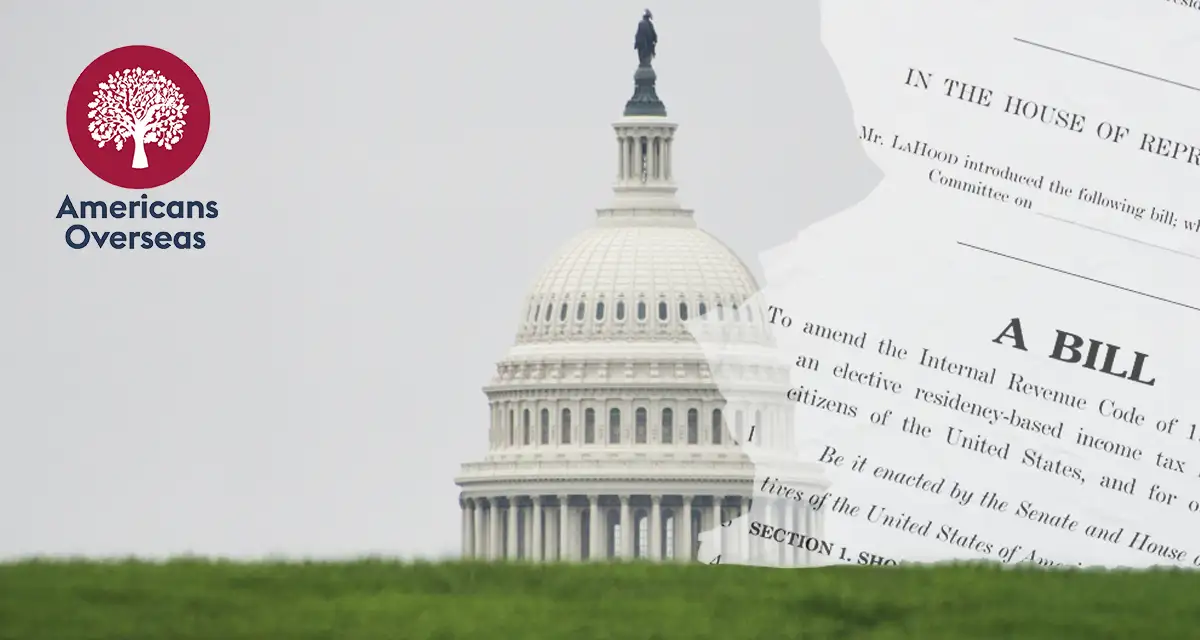
In early 2024, Representative Darin LaHood introduced the Residence-Based Taxation for Americans Abroad Act(H.R.10468), a legislative proposal aiming to replace the United States’ system of citizenship-based taxation with a residence-based taxation model for Americans living abroad.
The bill drew considerable attention from expatriate communities and advocacy organizations because it addressed one of the biggest long-term frustrations for Americans overseas: the obligation to remain in the U.S. tax system even when they live, work, and pay tax in another country. Yet despite the attention and support, the proposal has not moved forward. For now, it remains stalled.
This matters because millions of Americans abroad still face annual filing requirements, reporting obligations, professional fees, and ongoing uncertainty. For many, the issue is not only whether U.S. tax is actually owed, but whether the entire compliance framework remains fair and workable.
Unlike most countries, the United States taxes on the basis of citizenship rather than residence (Citizenship Based Taxation).That means U.S. citizens living abroad are generally still required to file U.S. tax returns and may need to report their worldwide income, even if they have not lived in the United States for many years. Eritrea is the only other country commonly cited as using a similar approach.
In practice, this system affects a wide range of people:
There are already mechanisms designed to reduce double taxation, such as the Foreign Earned Income Exclusion and foreign tax credits. But these do not remove the obligation to file, and they do not eliminate the complexity, cost, or risk of mistakes. Many Americans abroad owe little or no U.S. tax, yet still face extensive reporting obligations and potentially severe penalties if they miss forms or deadlines.
Residence-based taxation, often referred to as RBT, would change the basic framework. Instead of taxing Americans based on nationality, the U.S. would tax people based primarily on where they actually live.
That shift is significant. Under a residence-based model, qualifying Americans abroad would no longer be taxed by the United States on their foreign-source income simply because they hold U.S. citizenship. U.S.-source income would remain taxable, but foreign earnings would generally fall outside the U.S. system. This is the core principle behind LaHood’s proposal.
For many expats, that would represent a structural solution rather than another partial fix. The current system relies on exclusions, credits, treaty interactions, and careful filing. RBT would instead reduce the need for those workarounds by changing who is taxed in the first place.
If passed, the Residence-Based Taxation for Americans Abroad Act would allow qualified Americans overseas to opt into a new tax framework.
The proposal includes the following core features:
The improvement document adds an important nuance: the departure-tax threshold referenced in the proposal is framed as more relevant to higher-net-worth taxpayers, and this issue is one reason the bill has generated both support and criticism.
In other words, the bill is not simply a blanket exemption for all Americans abroad. It is designed as a conditional system, one that still emphasizes transparency, compliance, and continued taxation of U.S.-source income.
One of the main reasons Americans abroad support residence-based taxation is that it could fundamentally reduce the problem of double taxation.
Under the current system, many expats rely on the Foreign Earned Income Exclusion, the Foreign Tax Credit, and sometimes tax treaties to avoid being taxed twice on the same income. These tools help, but they do not solve every situation. Different income types are treated differently, local pension systems may not align neatly with U.S. rules, and business structures abroad can trigger additional U.S. reporting or tax consequences.
This is why many expats describe the problem not only as one of tax liability, but of compliance burden. Even when double taxation is reduced on paper, the compliance process itself remains expensive and stressful.
RBT would approach the issue more directly. If foreign-source income is no longer taxable in the United States for qualifying Americans abroad, the need to constantly offset foreign tax with U.S. credits and exclusions would be reduced. That is why supporters see the bill as a more durable answer than the current patchwork system.
For readers arriving at this topic through broader searches about expat taxes or U.S. citizen living abroad taxes, it is important to understand that the current system remains fully in place.
Today, Americans abroad may still need to:
That means that even if the RBT proposal sounds promising, it does not currently change anyone’s filing obligations. Americans abroad must still deal with the existing expat tax rules unless and until Congress actually passes new legislation.
FBAR filing is one of the most burdensome parts of U.S. compliance for many Americans abroad, and it is also one of the most searched expat-tax topics in the improvement brief.
FBAR would disappear under the proposed legislation, and the improvement document specifically treats this as unresolved rather than settled. That distinction matters. At this stage, it would be premature to suggest that residence-based taxation would automatically eliminate foreign account reporting obligations.
So the careful answer is this: as long as current law remains in place, FBAR filing obligations continue to apply where relevant. And even under a future RBT model, reporting requirements might not disappear entirely. Americans abroad should therefore not assume that proposed tax reform means they can stop reporting foreign accounts.
This issue is especially important for Accidental Americans.
Accidental Americans are people who are considered U.S. citizens, often because they were born in the United States or acquired citizenship through a parent, but who may have little or no practical connection to the country. Many discover their status only after a bank asks FATCA-related questions or blocks access to normal financial services.
For this group, the current system can feel particularly disproportionate. They may owe no U.S. tax, yet still face years of filings, compliance costs, and difficult decisions about whether to regularize their status or even renounce citizenship. Residence-based taxation is often seen as especially relevant for them because it could offer relief without forcing them to give up U.S. nationality.
At the same time, the proposal still appears to rely on compliance as a condition for relief. That means Accidental Americans should not assume that a future law would automatically solve everything without action on their part.
For some Americans abroad, especially those frustrated by years of compliance costs, renouncing U.S. citizenship has seemed like the only realistic exit.
That is why this bill matters beyond tax policy alone. It raises the possibility that some Americans abroad could keep their U.S. citizenship while no longer being taxed on foreign-source income simply because they live abroad. The improvement document explicitly notes that the link between RBT and renunciation is important and currently underdeveloped.
Still, renunciation and RBT are not the same thing. Renunciation is a legal and personal decision with long-term consequences. RBT, by contrast, would be a legislative reform that keeps citizenship in place while changing the tax framework for those who qualify.
For people considering expatriation, the key point is this: the proposal may eventually create an alternative, but it has not done so yet. Anyone weighing renunciation should assess their current position under existing law rather than making decisions based on a bill that remains uncertain.
The improvement brief also highlights digital nomads as a growing group with strong interest in residence-based taxation.
That makes sense. Americans who live across multiple jurisdictions often struggle even more with the current system because they may face overlapping filing questions, changing local tax rules, and uncertainty about where they are considered resident at any given time.
RBT could potentially simplify matters for some of these taxpayers, but it may also raise practical questions about how residence is defined for people without a stable long-term base. For that reason, digital nomads should view the proposal as potentially helpful, but not necessarily simple.
The bill has not been incorporated into major legislation and that its progress has been blocked by both political and procedural barriers. It specifically notes two obstacles:
The improvement brief adds useful context by noting that the bill expired with the end of the 118th Congress and would need to be reintroduced in the 119th Congress. It also notes that reintroduction had been expected but had not yet occurred as of the reference point used in that document.
In practical terms, that means the proposal remains politically relevant but legislatively unresolved.
To place the proposal in context, the improvement document suggests a brief timeline:
That history helps explain why many Americans abroad are interested, but cautious. This is not the first time reform has been discussed, and it is not yet a change people can rely on.
Supporters of the bill include advocacy groups such as American Citizens Abroad and Tax Fairness for Americans Abroad, both of which see the proposal as a necessary modernization of the U.S. approach to taxing citizens overseas. The argument in favor is straightforward: Americans abroad should not face years of costly compliance simply because they live outside the country.
At the same time, there are clear concerns. Critics worry that the bill could be framed as benefiting wealthier taxpayers or creating opportunities for tax avoidance. Others raise concerns about the effect on U.S. tax revenue. These objections are part of the political reason the bill remains difficult to advance, even though the current system is widely criticized among Americans abroad.
This is the most practical question for readers, and it is one of the most useful additions proposed in the improvement brief.
For now, Americans abroad should assume that the existing system still applies. That generally means:
This is especially important for people who are only now discovering that they may be considered a U.S. taxpayer. Waiting for Congress is rarely a compliance strategy.
LaHood’s proposal remains one of the clearest recent attempts to move the United States away from citizenship-based taxation and toward a residence-based model for Americans abroad. That is why it continues to attract attention.
But the proposal is still in limbo. It has not changed the law, and it has not removed the current filing and reporting burden on Americans overseas.
For now, the most realistic approach is to stay grounded: follow current rules, understand your position, and keep a close eye on developments. Reform may still come, but it is not here yet.
This article reflects the status described in the underlying source material and legislative commentary available at the time of writing. Tax legislation and political negotiations can change quickly.
Americans Overseas takes a careful and measured position. The organization recognizes that tax reform could benefit millions of expatriates, but it also stresses that caution is necessary until more is known about how any proposal would actually work in practice.
Americans Overseas therefore continues to advocate for fair and realistic reform, while also urging people to deal with their current obligations now rather than waiting for legislation that may or may not arrive.
As an advocacy organization for Americans required to file U.S. tax returns, Americans Overseas recognizes the potential benefits of tax reform for millions of expatriates. However, the group remains cautious about the details of the proposed bill and its long-term implications. In previous years, several attempts have been made to ease the burdens on Americans abroad. Americans Overseas welcomes these developments, but to truly speak of progress, we need more information about the feasibility and conditions. We don’t want to give people false hope.
One thing is clear: in all the proposals, the U.S. is seeking transparency and information, and if you want to qualify for relief, you must, perhaps logically, you have to be tax compliant.
Americans Overseas continues to advocate for fair and achievable reforms that address the needs of expatriates without creating undue economic consequences. In the meantime, the organization urges Americans living abroad to remain compliant with existing laws and regulations, as any future reforms would likely require adherence to current rules as a condition for participation.
Contact us for more information
Read more:
Sources:

General Manager & Partner
Linda Mabelis is the General Manager and Owner at Americans Overseas, dedicated to helping individuals find the right tax attorney for their unique situations. With extensive work experience and a deep understanding of the complexities facing Americans Overseas, Linda is committed to providing personalized and effective solutions.
Read more


Find out in 2 minutes whether the IRS considers you a “US Person” and whether you may be required to file a US tax return — even if you live outside the United States.

Below you will find answers to common questions about the Residence-Based Taxation for Americans Abroad Act, what it could mean for Americans living overseas, and what you should do while the proposal remains uncertain.
U.S. citizens and resident aliens who live abroad are generally required to file a federal income tax return and pay taxes on their worldwide income.
Read more... about Who is required to file taxes in the US?Yes, US citizens are required to file taxes on their worldwide income, regardless of where they are living.
Read more... about Do US citizens living abroad still have to file taxes in the US?Received an American check? You can cash your check in the following ways: cash the check at your own bank, transfer to another person (endorsement), cash checks using an online service or cash the check by another bank.
Read more... about How can I cash my US check?US citizens living abroad may be required to file Form 2555 and/or Form 1116 to claim the foreign-earned income exclusion.
Read more... about Are there any special tax forms required for US citizens living abroad?FBAR (Foreign Bank Account Report) filing is the requirement for certain U.S. individuals and entities to report their foreign financial accounts to the Financial Crimes Enforcement Network (FinCEN) of the U.S. Department of Treasury. The FBAR filing requirement applies to U.S. persons who have a financial interest in, or signature authority over, one or more foreign financial accounts if the aggregate value of those accounts exceeds $10,000 at any time during the calendar year.
Read more... about What is FBAR filing?Residence-based taxation would mean that Americans living abroad are taxed primarily based on where they live, rather than simply because they hold U.S. citizenship. Under the current system, many Americans overseas must still file U.S. tax returns and report worldwide income. If a residence-based taxation model were introduced, qualifying expats would generally no longer be taxed by the United States on foreign-source income, although U.S.-source income would likely remain taxable.
Under the current system, Americans abroad may be able to reduce double taxation through mechanisms such as the Foreign Earned Income Exclusion, the Foreign Tax Credit, and in some cases tax treaties. These tools can help, but they do not remove the obligation to file a U.S. tax return. They also do not eliminate the complexity of the system, especially for people with pensions, self-employment income, foreign companies, or mixed sources of income.
That is not yet clear. The proposal focuses mainly on income taxation, and it would be premature to assume that foreign account reporting obligations such as FBAR filing would automatically disappear. For now, Americans abroad should assume that existing FBAR rules still apply where required and should remain compliant until any new law is actually passed and clarified.
For Accidental Americans, this type of reform could be highly significant. Many Accidental Americans have little practical connection to the United States, yet still face U.S. filing obligations because of citizenship. A residence-based system could potentially reduce that burden. At the same time, the proposal appears to require tax compliance as a condition for relief, so it would not necessarily solve everything automatically for people who have never filed.
At this stage, there is still too much uncertainty to say. The proposal has attracted attention and support, but it has also faced procedural and political obstacles. It has not yet become law, and previous reform efforts for Americans abroad have often stalled. That is why it is better to see residence-based taxation as a serious proposal rather than a guaranteed upcoming change.
Yes. As long as the law has not changed, existing U.S. tax filing and reporting obligations still apply. Americans living abroad should not stop filing on the assumption that reform may happen later. Any future relief would also likely depend on current compliance, so remaining up to date is the safest approach.
The proposal includes a one-time departure tax aimed at high-net-worth individuals. According to the bill summary in the existing article, this would apply to people above a certain wealth threshold, while long-term expats who have been tax compliant for five consecutive years may be able to avoid it. The exact scope and application would depend on the final legislative text if the proposal ever becomes law.
Digital nomads may find the idea of residence-based taxation attractive because the current system can become especially complex when income and residence are spread across multiple jurisdictions. However, digital nomads may also face difficult questions about where they are actually resident for tax purposes. So while the proposal could simplify matters for some, it may not be straightforward for people without a clear long-term country of residence.