



Americans Are Giving Up Their Citizenship at Record Rates, but not because of Trump
3 min
22-02-2017
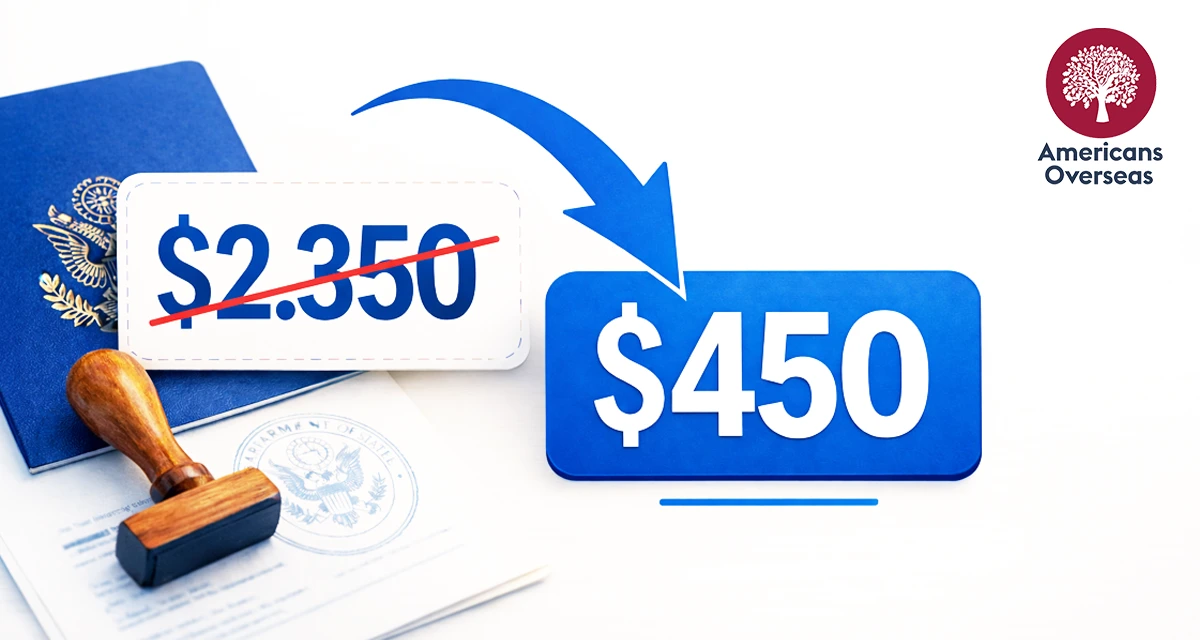
The fee for renouncing U.S. citizenship is being reduced from $2,350 to $450. The new rule takes effect on April 13, 2026, but implementation still depends on U.S. embassies and consulates.
On March 13, 2026, the U.S. Department of State published a final rule in the Federal Register. This officially confirms the reduction of the fee for the administrative processing of a Certificate of Loss of Nationality (CLN). For Americans abroad who are considering renouncing their U.S. citizenship, this is a relevant development. The fee will be reduced from $2,350 to $450, and the new rule takes effect on April 13, 2026.
However, the lower fee does not change the fact that procedures, appointment availability, and waiting times can vary greatly from one consulate to another. In practice, renouncing U.S. citizenship is still handled through the local U.S. embassy or consulate, each with its own procedures and appointment system.
The fee for processing a request for a Certificate of Loss of Nationality will be reduced from:
This fee applies to individuals who formally renounce their U.S. citizenship, or otherwise lose their U.S. nationality under U.S. law, and apply for a Certificate of Loss of Nationality through a U.S. embassy or consulate.
The rule was published on March 13, 2026 and takes effect on April 13, 2026.
Although the rule has now been finalized, it is important to stress that Americans Overseas has no role in implementing this measure.
The procedures for renouncing U.S. citizenship are fully managed by the U.S. Department of State and the individual U.S. embassies and consulates. In practice, this means consulates determine:
Everyone is therefore dependent on how the U.S. consulates implement this change. We recommend that members always check directly with their local embassy or consulate which fee applies at the time of their appointment.
Renouncing U.S. citizenship is a very significant step and, in principle, an irreversible one. Once citizenship has been renounced and a Certificate of Loss of Nationality has been issued, that decision cannot simply be undone.
Losing U.S. citizenship may have consequences for:
That is why it is important for anyone considering this step to become properly informed and to carefully weigh the possible consequences before making a final decision.
Read more in our knowledge center article: I am considering renouncing my U.S. citizenship.
The fee reduction was originally proposed in October 2023. After a period of public comments and internal review within the U.S. government, the Department of State has now finalized the rule and amended the Schedule of Fees for Consular Services.
For many Americans abroad, the previous fee of $2,350 had long been seen as a substantial financial barrier. The new fee of $450 therefore represents a significant reduction, although it remains a formal consular procedure.
Renouncing U.S. citizenship does not automatically mean that all tax obligations end immediately.
Individuals who renounce their citizenship must state that they have been, or will become, fully compliant with their U.S. tax filings for the five years preceding renunciation. In addition, a tax return must also be filed for the year of renunciation.
This is confirmed by filing IRS Form 8854 with the IRS. Depending on income, assets, and prior tax status, someone who renounces may also be subject to the so-called exit tax. Americans Overseas also points out that tax compliance and possible covered expatriate rules can play an important role here.
Because the tax consequences can be complex and differ from person to person, it may be wise to seek professional tax advice through Americans Overseas in advance.
For some Americans abroad who have not fully complied with their U.S. tax filing obligations, it may be possible to use the Streamlined Foreign Offshore Procedures. This IRS program is intended for taxpayers who failed to file their returns without willful intent (“non-willful”).
Through this procedure, overdue tax returns and reporting obligations can still be submitted so that the taxpayer can become compliant again. Because the conditions and consequences differ by situation, it is advisable to seek advice from a tax specialist before taking further steps.
A lower fee does not change the fact that waiting times and procedures at U.S. consulates vary widely. This applies within Europe as well as outside Europe. Anyone considering renunciation and who is not yet up to date with their U.S. tax filings would be wise to seek advice in time.
Without proper preparation, the total cost may end up being higher than just the consular fee. This may include the cost of preparing missing tax returns, possible amnesty or disclosure procedures, and final expatriation documentation.
In addition, there will likely be very few quick renunciation cases in the near future: implementation remains dependent on local consulates, while interest may increase precisely because of this fee reduction. Local implementation may also differ by post. In other words, these lower renunciation costs in 2026 do not automatically mean that the process will become faster or easier.
The Americans Overseas team is generally well informed about waiting times and procedures. Feel free to contact us without obligation if you are considering renunciation and first want to map out your tax and practical position properly.
For some people involved, FATCA also plays a role in the background. FATCA requires financial institutions to report information on U.S. account holders, and in the Netherlands this exchange of information with the IRS is continuing for the time being.
Americans Overseas recently also reported on the ruling by the District Court of Gelderland that the Netherlands may continue sharing FATCA data of Accidental Americans with the IRS.
Americans Overseas will continue to monitor how this change is implemented by U.S. consulates worldwide and will keep members informed of relevant developments affecting Americans abroad.
The fee reduction is an important development, but it does not resolve all of the practical and tax questions surrounding renunciation of U.S. citizenship. That is precisely why careful preparation remains essential.
Contact us for more information
Source
Federal Register – U.S. Department of State, Schedule of Fees for Consular Services—Fee for Administrative Processing of Request for Certificate of Loss of Nationality, published on March 13, 2026, effective April 13, 2026.
Understanding the US tax system, the obligations, and all the additional terms can be difficult. Especially if one lives outside of America. Is your question not answered? Contact us.
U.S. citizens and resident aliens who live abroad are generally required to file a federal income tax return and pay taxes on their worldwide income.
Read more... about Who is required to file taxes in the US?Yes, US citizens are required to file taxes on their worldwide income, regardless of where they are living.
Read more... about Do US citizens living abroad still have to file taxes in the US?Received an American check? You can cash your check in the following ways: cash the check at your own bank, transfer to another person (endorsement), cash checks using an online service or cash the check by another bank.
Read more... about How can I cash my US check?US citizens living abroad may be required to file Form 2555 and/or Form 1116 to claim the foreign-earned income exclusion.
Read more... about Are there any special tax forms required for US citizens living abroad?FBAR (Foreign Bank Account Report) filing is the requirement for certain U.S. individuals and entities to report their foreign financial accounts to the Financial Crimes Enforcement Network (FinCEN) of the U.S. Department of Treasury. The FBAR filing requirement applies to U.S. persons who have a financial interest in, or signature authority over, one or more foreign financial accounts if the aggregate value of those accounts exceeds $10,000 at any time during the calendar year.
Read more... about What is FBAR filing?Yes. The U.S. Department of State has published a final rule reducing the fee for the administrative processing of a Certificate of Loss of Nationality (CLN) from $2,350 to $450.
The new rule was published on March 13, 2026 and takes effect on April 13, 2026.
Not necessarily in practice. Although the rule takes effect on April 13, 2026, implementation still depends on U.S. embassies and consulates. They determine when appointments are available and when the new fee is actually applied.
The fee applies to the administrative processing of a Certificate of Loss of Nationality. That includes people who formally renounce U.S. citizenship, but also other situations in which a person loses U.S. nationality under U.S. law and applies for a CLN.
No. The lower fee does not change the fact that waiting times, appointment availability, and procedures can vary significantly from one consulate to another.
In many cases, yes. People who renounce U.S. citizenship generally need to confirm that they have been fully compliant with their U.S. tax filing obligations for the five years before renunciation. A tax return must also usually be filed for the year of renunciation, including IRS Form 8854.
For some Americans abroad, the Streamlined Foreign Offshore Procedures may be an option. This IRS program is designed for taxpayers who failed to file without willful intent. Through this procedure, overdue returns and reports can still be filed so that the taxpayer can become compliant again.
Yes, possibly. Depending on your income, assets, and prior tax position, you may be subject to U.S. exit tax rules when renouncing.
No. Americans Overseas does not carry out the consular procedure. Formal renunciation of U.S. citizenship is handled entirely by the U.S. Department of State and the relevant U.S. embassy or consulate. Americans Overseas can, however, help with information, tax preparation, and guidance on the consequences.