


5 facts If you never filed US taxes
3 min
25-02-2016
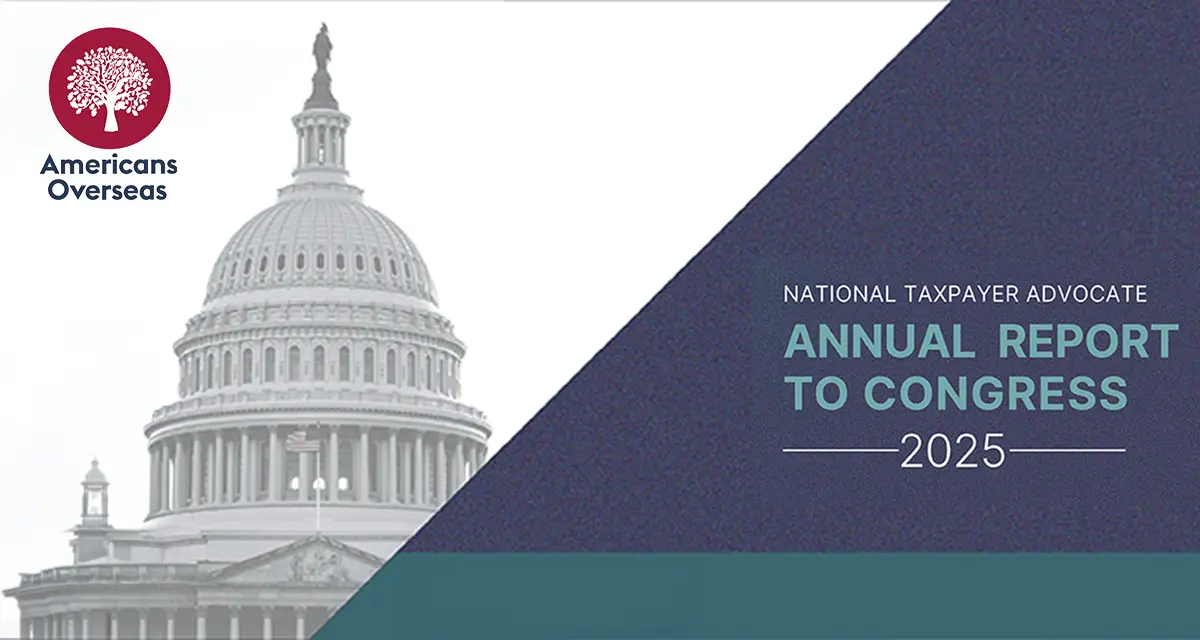
Many Americans living abroad experience that the U.S. tax system does not align well with life outside the United States. This perception is now formally acknowledged: in her latest report to Congress, the U.S. National Taxpayer Advocate once again identifies Americans abroad as a major structural problem group.
In January 2026, the U.S. National Taxpayer Advocate published her Annual Report to Congress 2025.
This annual report outlines the most significant challenges within the U.S. tax system.
Notably, Americans living outside the United States are once again explicitly identified as a problem group. For many people who have never consciously identified as American — including Accidental Americans — this reflects their day-to-day reality.
The report dedicates an entire chapter to Taxpayers Living Abroad.
In it, the National Taxpayer Advocate explains that Americans outside the U.S. face a combination of requirements that are often difficult to manage in practice, including:
the obligation to file U.S. tax returns, even when taxes are already paid in the country of residence
limited access to IRS assistance from abroad
According to the report, this combination results in a significant administrative burden, particularly for individuals with ordinary local incomes and no complex financial arrangements.
An important observation in the report is that the IRS itself has limited insight into how many Americans actually live abroad, let alone how many are fully compliant.
Without reliable data, it becomes difficult to:
assess the scale of the challenges faced by Americans abroad
adapt policies to the realities of living outside the U.S.
improve services in a targeted and effective way
For many Accidental Americans, this is a familiar situation: extensive obligations combined with limited guidance and support.
The report also emphasizes that most Americans living abroad are not wealthy expats.
Many earn incomes only slightly above — or even below — the Foreign Earned Income Exclusion (FEIE) threshold.
Despite this, they may still be fully drawn into the U.S. tax system, often resulting in:
complex tax filings
additional forms and disclosures
high professional compliance costs
stress and uncertainty
This applies even when little or no additional U.S. tax is ultimately owed.
The report does not call for the immediate abolition of citizenship-based taxation, nor does it announce concrete legislative changes.
However, it does formally acknowledge that:
the system places a disproportionate burden on Americans abroad
regulations can lead to financial strain and even banking difficulties
improvements in service and administration are urgently needed
The report also notes that the United States remains one of the few countries that taxes its citizens on worldwide income regardless of where they live.
For Accidental Americans, the report does not change existing rules.
U.S. tax filing obligations, as well as FATCA and FBAR reporting requirements, remain in place.
What the report does show is that these challenges are recognized at the highest policy level, even if structural reform remains uncertain.
At Americans Overseas, we closely monitor these developments while remaining realistic. As long as the current rules apply, it is important to understand when they affect you, what is actually required, and which options exist within the current framework.
We, the founders of Americans Overseas, were born in the Netherlands and received our American citizenship through our (American) mother.
When we first learned about the U.S.–Netherlands tax treaty around 2013, we felt disbelief (“this can’t be true”), anger (“how can they do this?”), fear (“will I get fined or have problems?”), and panic (“what should I do?”).
Unfortunately, it is true that there is a U.S. tax obligation for Dutch citizens who acquired American nationality by birth. There was no information from local authorities, the U.S. consulate referred us to the IRS, and the IRS itself was impenetrable.
That is why we started this initiative: to help others with reliable information, to prevent unnecessary panic, and to offer free, no‑obligation assistance. When needed, we can connect you with a network of affordable professionals (accountants) who can help you meet your U.S. tax obligations.
Contact us for more information
Source:
Annual Report to Congress 2025 – National Taxpayer Advocate

General Manager & Partner
Linda Mabelis is the General Manager and Owner at Americans Overseas, dedicated to helping individuals find the right tax attorney for their unique situations. With extensive work experience and a deep understanding of the complexities facing Americans Overseas, Linda is committed to providing personalized and effective solutions.
Read more