


AI Does Your US Tax Return (Almost) Right – But “Almost Right” Is Still Wrong with the IRS
5 min
11-11-2025
An AI tax return sounds efficient: faster, less hassle, and maybe even a bigger refund. Now that more people use AI for practical questions, it is not surprising that tax matters are next.
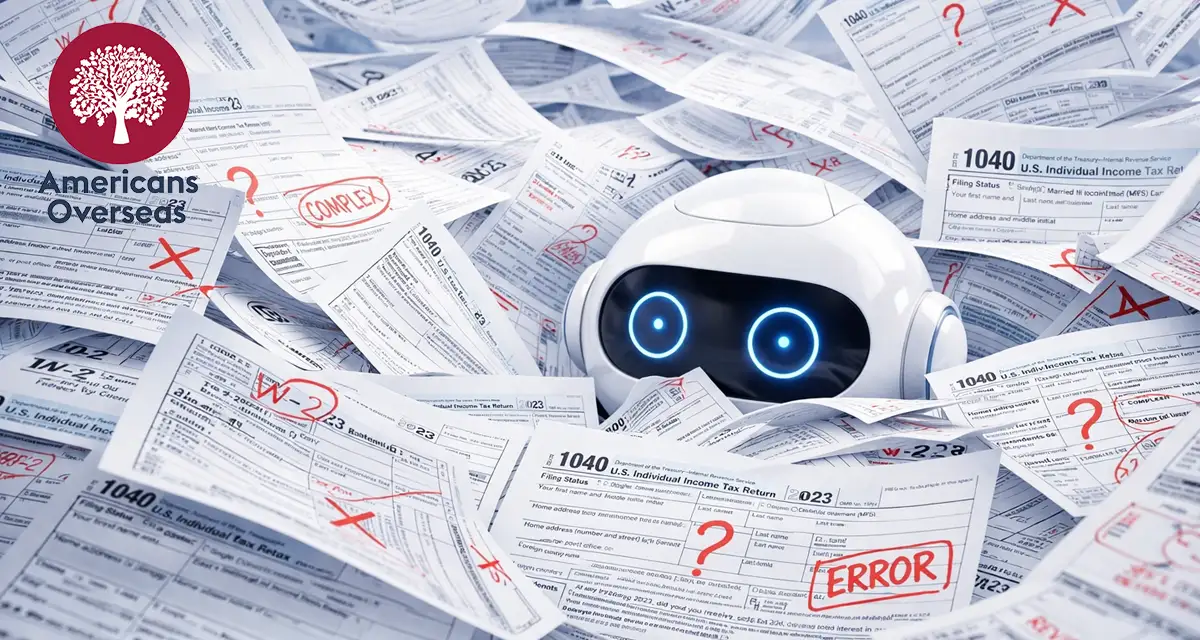
Still, there is good reason to be cautious. The New York Times tested four well-known AI chatbots on fictional US tax scenarios. On average, the results were off by more than $2,000. Even when all the necessary documents were available, the models still made mistakes in calculations and in how information was processed.
For Americans living abroad, that matters even more. Their tax position is often more complex than average, because US rules interact with local tax law, foreign bank accounts, and additional reporting obligations.
That does not mean AI has no value. On the contrary, it can be useful at the start of the process. It can help make tax concepts easier to understand, bring structure to documents, and provide a quicker overview. It can also be helpful for simple tax questions or for explaining a difficult IRS form.
For expats, that can be especially appealing. When you are dealing with topics like FBAR, FATCA, foreign tax credits, or a tax treaty for the first time, you often want clarity before taking real next steps.
AI can, for example, help you to:
The problem starts when AI is no longer used as an assistant, but as a substitute for real tax judgment.
A tax return is not a rough draft. It is a legal document. And that is exactly where AI often falls short. These models can sound convincing, but they regularly miss the connections between forms, exceptions, and the sequence in which information needs to be processed. In tax matters, those are not minor details. They are often the parts that determine the outcome.
On top of that, AI often does not fully understand your overall financial context. An answer may sound logical and still be wrong. And in the end, you remain responsible before the IRS.
Many people assume that an AI tax return is still useful if an expert checks it afterward. In practice, it usually works differently. A tax advisor will often start again from scratch.
There are several reasons for that. First, there is liability. The advisor is legally responsible for the return that is prepared or submitted, so they cannot simply rely on AI output. Second, there is a documentation requirement: the underlying records still need to be reviewed and validated. A chatbot summary is not enough. Third, tax professionals work with their own software, review procedures, and fixed workflows. An AI-generated draft usually does not fit well into that process.
What feels like a time saver often becomes an extra step instead.
It is a bit like walking into a bakery and saying: I already kneaded the dough, can you now turn it into a good loaf of bread?
The baker will usually start over anyway. Not because the preparation was worthless, but because the baker is responsible for the final result, has to follow a proven process, and needs to stand behind the quality.
That is essentially how tax advice works as well.
An AI tax return may seem to save time, but in practice it often creates extra work as well. Results need to be checked, assumptions need to be reconsidered, and mistakes need to be corrected. What began as a shortcut can easily turn into more work for both you and your advisor.
In a tax context, that often means:
For this group, the situation is usually even less standard. Think of tax treaties, foreign tax credits, foreign businesses, investments, and double reporting obligations such as FBAR and FATCA. These are exactly the areas where nuance matters, and exactly where AI often falls short.
That is why an AI tax return is especially risky for expats. The more international your situation, the greater the chance that a chatbot overlooks something or presents it too simply.
AI can be a smart tool, but it is not a tax advisor. Use it to understand concepts, formulate questions, and get a clearer overview. Do not use it as a replacement for professional judgment or as the basis for a complex US tax return.
For Americans abroad in particular, human expertise remains necessary to avoid errors, risk, and false confidence.
We, the founders of Americans Overseas, were born in the Netherlands and received our American citizenship through our (American) mother.
When we first learned about the U.S.–Netherlands tax treaty around 2013, we felt disbelief (“this can’t be true”), anger (“how can they do this?”), fear (“will I get fined or have problems?”), and panic (“what should I do?”).
Unfortunately, it is true that there is a U.S. tax obligation for Dutch citizens who acquired American nationality by birth. There was no information from local authorities, the U.S. consulate referred us to the IRS, and the IRS itself was impenetrable.
That is why we started this initiative: to help others with reliable information, to prevent unnecessary panic, and to offer free, no‑obligation assistance. When needed, we can connect you with a network of affordable professionals (accountants) who can help you meet your U.S. tax obligations
Contact us for more information
Source
The New York Times tested four AI chatbots on fictional US tax returns. The results differed by more than $2,000 on average, and errors remained even when full documentation was available.

General Manager & Partner
Linda Mabelis is the General Manager and Owner at Americans Overseas, dedicated to helping individuals find the right tax attorney for their unique situations. With extensive work experience and a deep understanding of the complexities facing Americans Overseas, Linda is committed to providing personalized and effective solutions.
Read more