



Are you an American living in Europe trying to renounce your US citizenship?
4 min
22-02-2022
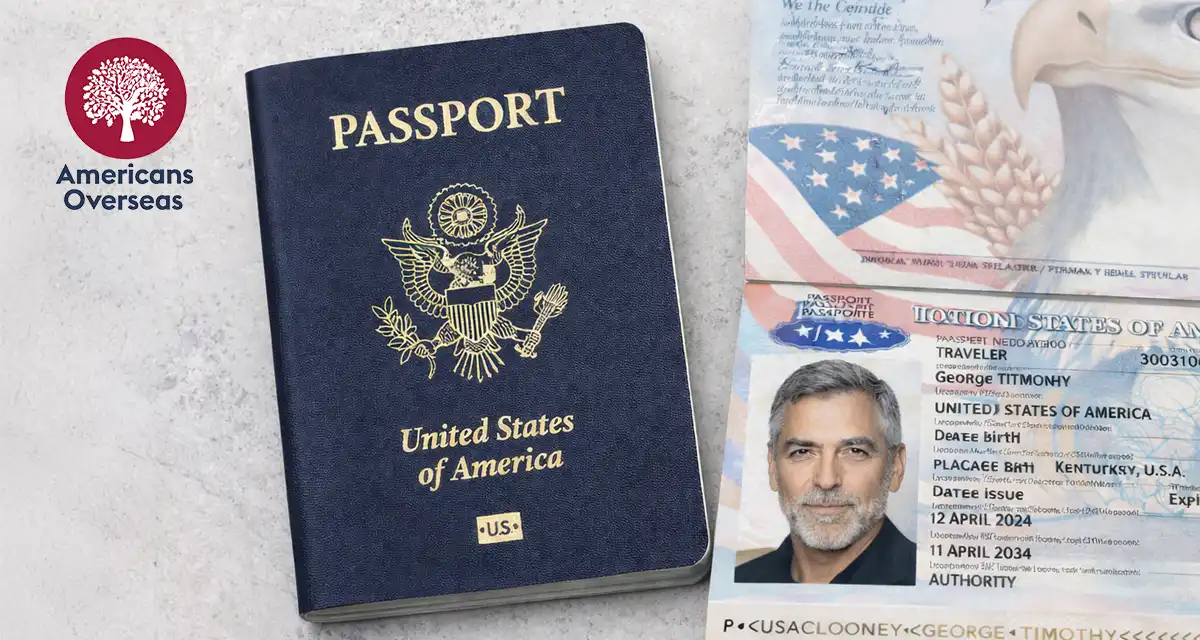
When France recently granted citizenship to George Clooney, his wife Amal, and their children, media coverage focused largely on celebrity and politics. Yet beyond the headlines lies a question many Americans living abroad quietly ask themselves: whether renouncing U.S. citizenship makes sense when their lives, families, and financial futures are firmly rooted outside the United States.
Clooney has not announced any intention to give up his U.S. passport. Still, his situation highlights the same legal, tax, and administrative realities faced by thousands of Americans overseas each year. For many, those realities include ongoing IRS filing obligations, complex international tax rules, and financial restrictions that continue long after leaving the U.S.
Clooney’s newly confirmed French nationality marks a clear shift away from Los Angeles, long the center of his professional life. He has said he prefers raising his children in France, citing privacy and a more balanced lifestyle away from Hollywood scrutiny.
The move also drew political commentary. Former President Donald Trump publicly mocked the Clooneys’ French citizenship, calling them “two of the worst political prognosticators of all time.” Clooney responded with characteristic irony:
“I totally agree with the current president,” he said. “We have to make America great again. We’ll start in November.”
Despite the exchange, the central issue remains practical rather than political. While Clooney has stated he is “not abandoning L.A.” and has not renounced U.S. citizenship, the possibility alone has renewed attention on a growing trend among Americans abroad.
Each year, approximately 5,000 to 6,000 Americans formally renounce U.S. citizenship, most often for tax and administrative reasons. In Clooney’s case, observers note that renunciation would involve more than symbolism: it would likely trigger significant U.S. tax consequences.
For Americans living outside the United States, maintaining U.S. citizenship can come with substantial ongoing obligations. The U.S. is one of only two countries in the world- alongside Eritrea -that taxes based on citizenship rather than residency. As a result, U.S. citizens abroad must file annual tax returns with the IRS regardless of where they live or earn income.
High-profile cases illustrate this burden. Former UK Prime Minister Boris Johnson, who held U.S. citizenship by birth, renounced in 2016 after receiving what he described as an “absolutely outrageous” IRS tax bill following the sale of his London home.
For everyday Americans abroad, challenges often include overlapping tax systems, high professional compliance costs, and complex reporting requirements for foreign bank accounts under FATCA. Many non-U.S. banks restrict services or impose additional fees on U.S. citizens because of U.S. reporting rules. In countries such as Japan or Qatar, where dual citizenship is not permitted, Americans may be forced to choose between nationalities.
In addition to annual tax returns, many Americans abroad are also required to file FBARs (Foreign Bank Account Reports) if the combined balance of their non-U.S. accounts exceeds $10,000 at any point during the year. FBAR penalties for non-compliance can be severe—even when no U.S. tax is owed—adding another layer of stress and risk for expats who may already feel overwhelmed by U.S. reporting obligations.
Financial considerations are a major driver. Expats may face unexpected U.S. taxes when selling property, investing locally, or planning retirement abroad. Surveys show that 61% of Americans considering renunciation cite the U.S. tax burden as a primary reason, followed closely by dissatisfaction with U.S. government policies.
In 2024, approximately 4,820 Americans renounced U.S. citizenship—an increase of 48% over the previous year and one of the highest totals on record.
A major concern—particularly for high-net-worth individuals—is the U.S. Exit Tax. When certain Americans renounce citizenship, the IRS treats them as if they sold all worldwide assets the day before expatriation. Any unrealized gains may be subject to capital gains tax, potentially up to 23.8%.
The Exit Tax applies only to individuals classified as “covered expatriates.” Under current law, you fall into this category if you meet any of the following criteria:
Net worth over $2 million
If your total worldwide assets exceed $2 million, you are considered a covered expatriate. With an estimated net worth in the hundreds of millions, Clooney would clearly meet this test.
High average tax liability
If your average annual U.S. income tax for the previous five years exceeds a set threshold (approximately $211,000 for 2026), you are covered.
Failure to certify tax compliance
If you cannot certify full U.S. tax compliance for the five years prior to expatriation on Form 8854, you are automatically treated as a covered expatriate—regardless of net worth.
The IRS allows an exclusion (approximately $890,000 of gains in 2025), but gains above that amount are taxed at standard capital gains rates. When assets such as real estate, investments, businesses, and pensions are included, the resulting tax bill can be significant.
Importantly, most Americans who renounce do not owe Exit Tax. The majority do not meet the financial thresholds and ultimately pay no one-time tax at all.
Even when no Exit Tax is due, however, the process of expatriation itself can be complex and costly. Many Americans require professional assistance to ensure five years of tax compliance, resolve past filing gaps, complete outstanding FBAR obligations, and correctly file the final U.S. tax return and Form 8854. As a result, expatriation services can represent a steep upfront expense—particularly for those with long or complicated compliance histories—but errors or omissions can prove far more costly in the long run.
Find out in 2 minutes whether the IRS considers you a “US Person” and whether you may be required to file a US tax return — even if you live outside the United States.
Renouncing U.S. citizenship is a serious legal step that extends far beyond taxes. Anyone considering this decision should carefully evaluate the following:
Irrevocability
Renunciation is intended to be permanent. During the process, you must confirm that you understand this and that reversal is extremely rare.
Process and Fees
Renunciation requires an in-person appointment at a U.S. embassy or consulate, a signed oath, and a State Department fee of $2,350 (Update March 17, 2026: the fee is lowered to $ 450). You must also file a final dual-status tax return and Form 8854.
Tax Compliance, FBARs, and Exit Tax
You must be fully compliant with U.S. tax filing and FBAR reporting for the five years prior to renunciation. Covered expatriates must calculate Exit Tax; others will owe only standard final-year tax, if any.
Loss of Benefits
Certain benefits, including aspects of Social Security, voting rights, and U.S. consular protection, may be reduced or lost depending on treaties and residency.
Travel to the United States
After renunciation, you enter the U.S. as a foreign national and require a visa or ESTA authorization. Visits are generally possible with proper planning.
Public Disclosure
Names of individuals who renounce are published in the Federal Register. While no financial details are disclosed, the act is not private.
Other Citizenship Obligations
You must already hold—or be approved for—another nationality. Some countries impose military service or other civic duties that should be considered in advance.
Despite persistent rumors, renunciation does not automatically bar future entry into the United States. Although U.S. law includes a provision allowing denial of entry for tax-motivated expatriation, it is rarely enforced in practice.
We, the founders of Americans Overseas, were born in the Netherlands and received our American citizenship through our (American) mother.
When we first learned about the U.S.–Netherlands tax treaty around 2013, we felt disbelief (“this can’t be true”), anger (“how can they do this?”), fear (“will I get fined or have problems?”), and panic (“what should I do?”).
Unfortunately, it is true that there is a U.S. tax obligation for Dutch citizens who acquired American nationality by birth. There was no information from local authorities, the U.S. consulate referred us to the IRS, and the IRS itself was impenetrable.
That is why we started this initiative: to help others with reliable information, to prevent unnecessary panic, and to offer free, no‑obligation assistance. When needed, we can connect you with a network of affordable professionals (accountants) who can help you meet your U.S. tax obligations.

General Manager & Partner
Linda Mabelis is the General Manager and Owner at Americans Overseas, dedicated to helping individuals find the right tax attorney for their unique situations. With extensive work experience and a deep understanding of the complexities facing Americans Overseas, Linda is committed to providing personalized and effective solutions.
Read more